Will AI modernize your legacy system, or just rewrite it?
The rewrite compiles. The tests pass. Nobody can say whether the line it dropped was a bug, a workaround, or a promise to a customer.
- 92% 47%
- Equivalence of an AI migration, simple features versus complex ones.arXiv 2608.28972
- 0%
- Behavioral tests passed by one-shot AI migrations that compiled and ran.arXiv 2605.17535
- Stories
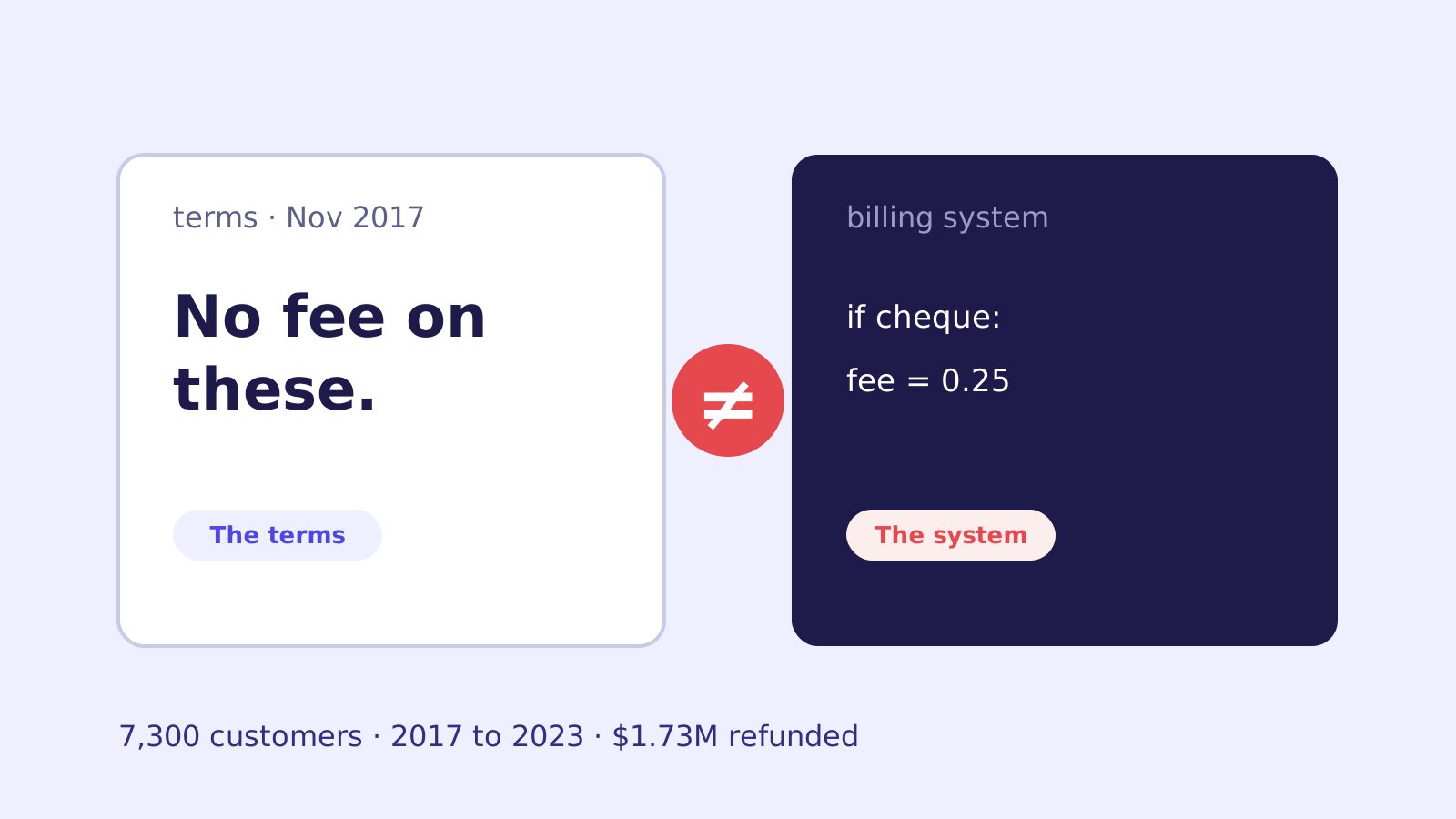
You changed your terms. What is your system still charging?
A New Zealand bank charged a fee for six years that its own terms said did not exist. Five questions to run this week on any rule whose reason has ended.
- Research
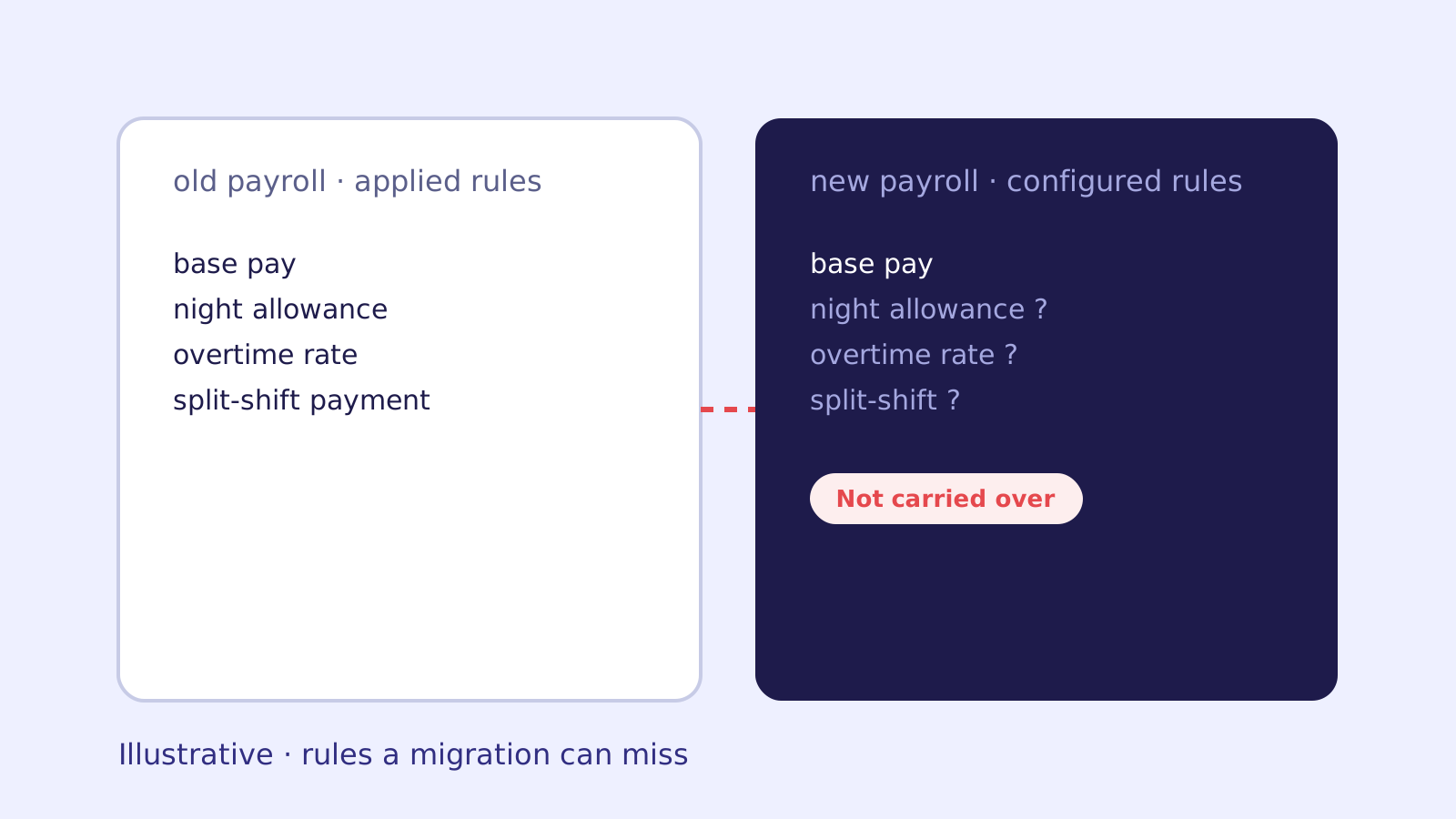
Payroll went live and people are underpaid. Where do you look?
Sydney Water replaced its payroll system in July 2026. By late September three unions were taking industrial action over pay that arrived late, short or not at all. The question every migration team should ask before go-live is which rules the old system was applying.
- Leadership
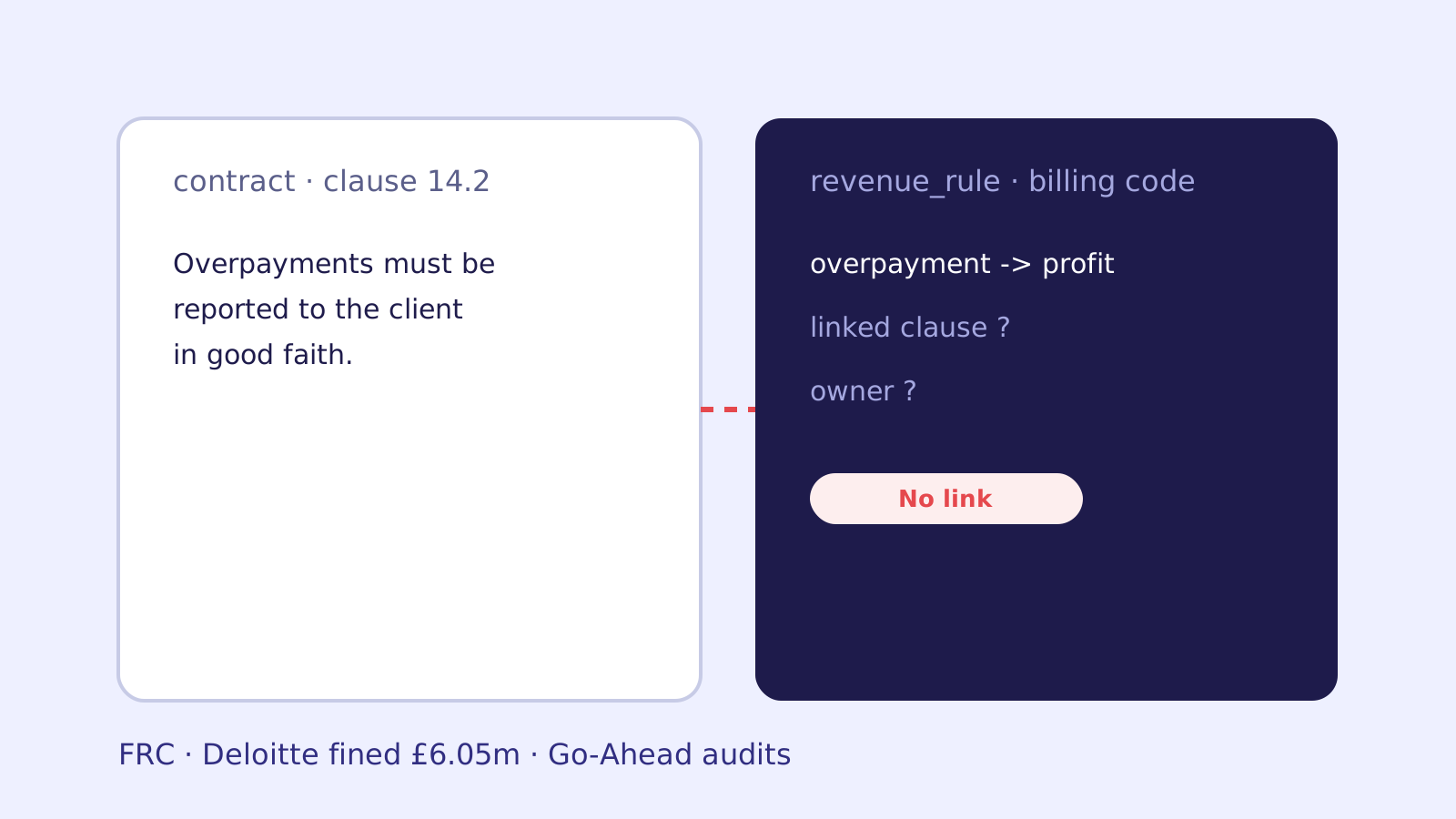
Can you show an auditor which contract term a rule enforces?
A UK regulator fined Deloitte £6.05 million for missing the contract terms behind overpayments Go-Ahead's rail subsidiaries booked as profit. The same link, from contract to rule, is the one your own audit will ask for.
 Stories
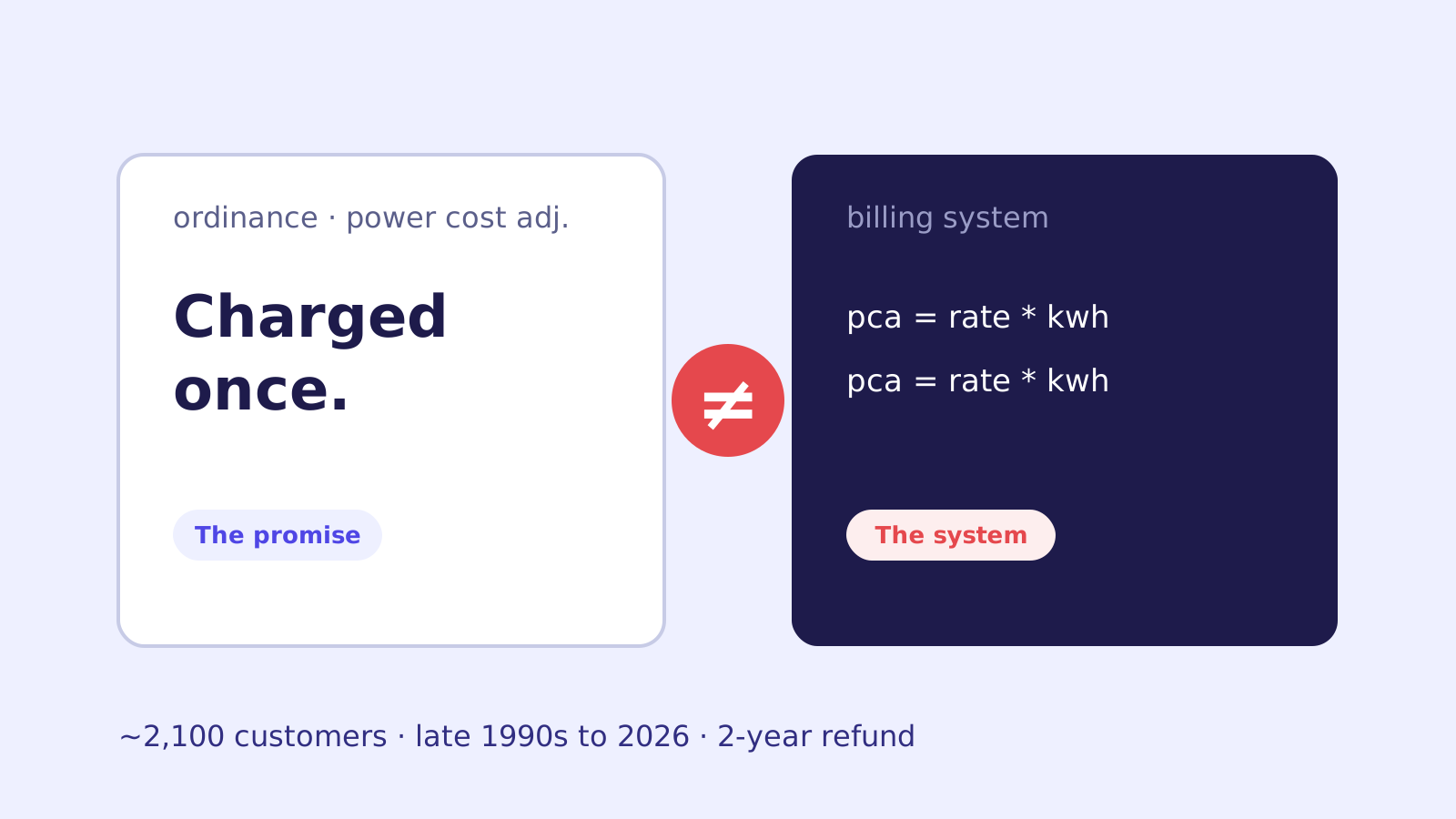
A billing error ran for decades. How would you find yours?
A Texas city overcharged electricity customers for roughly 30 years because a rule did something different from what its ordinance said. A customer noticed first.
 Leadership
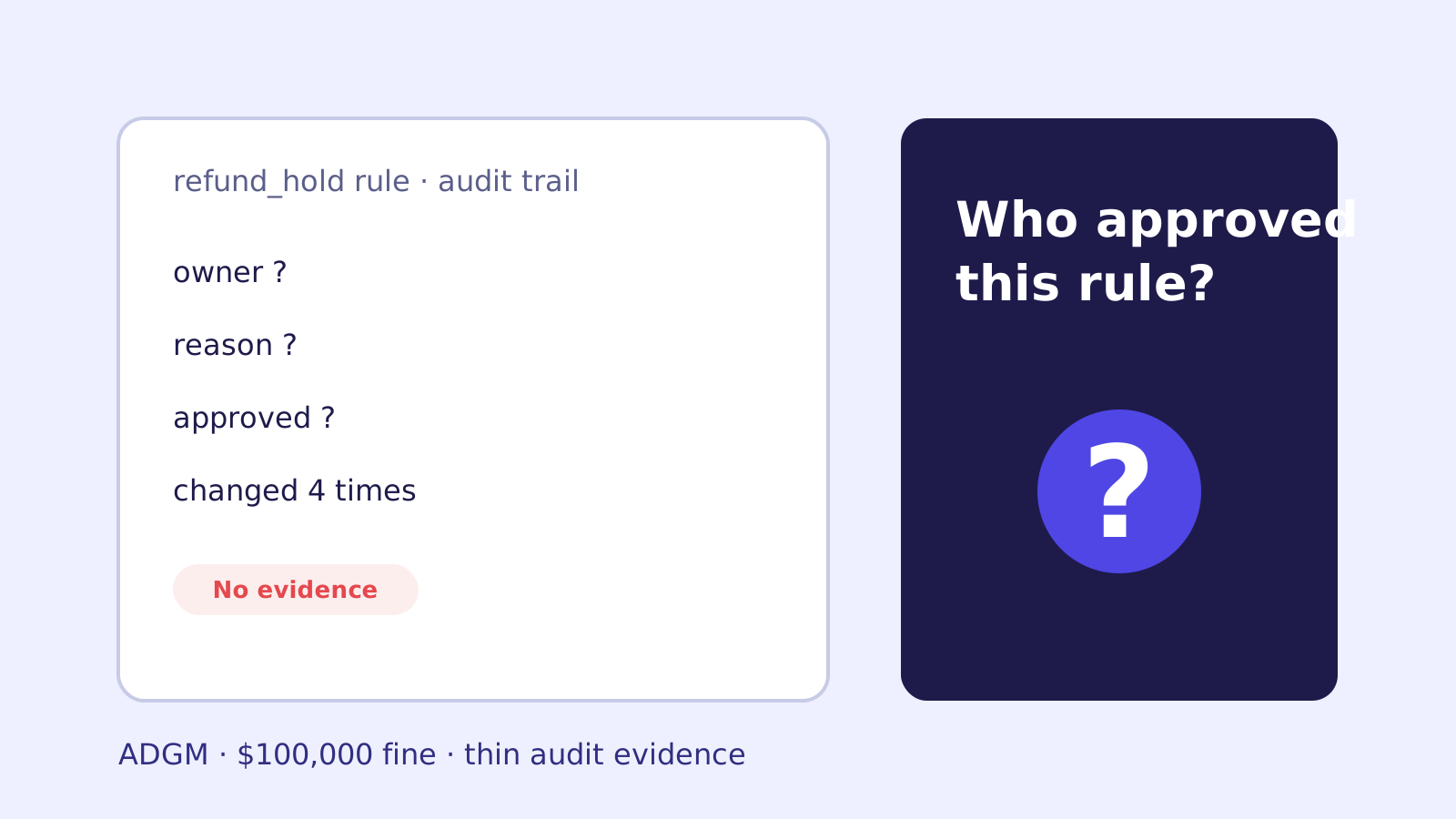
The auditor asks who approved this rule. What do you show?
An Abu Dhabi regulator fined an audit firm for thin evidence and no record of who supervised. The same question lands on every company's own controls.
 Stories
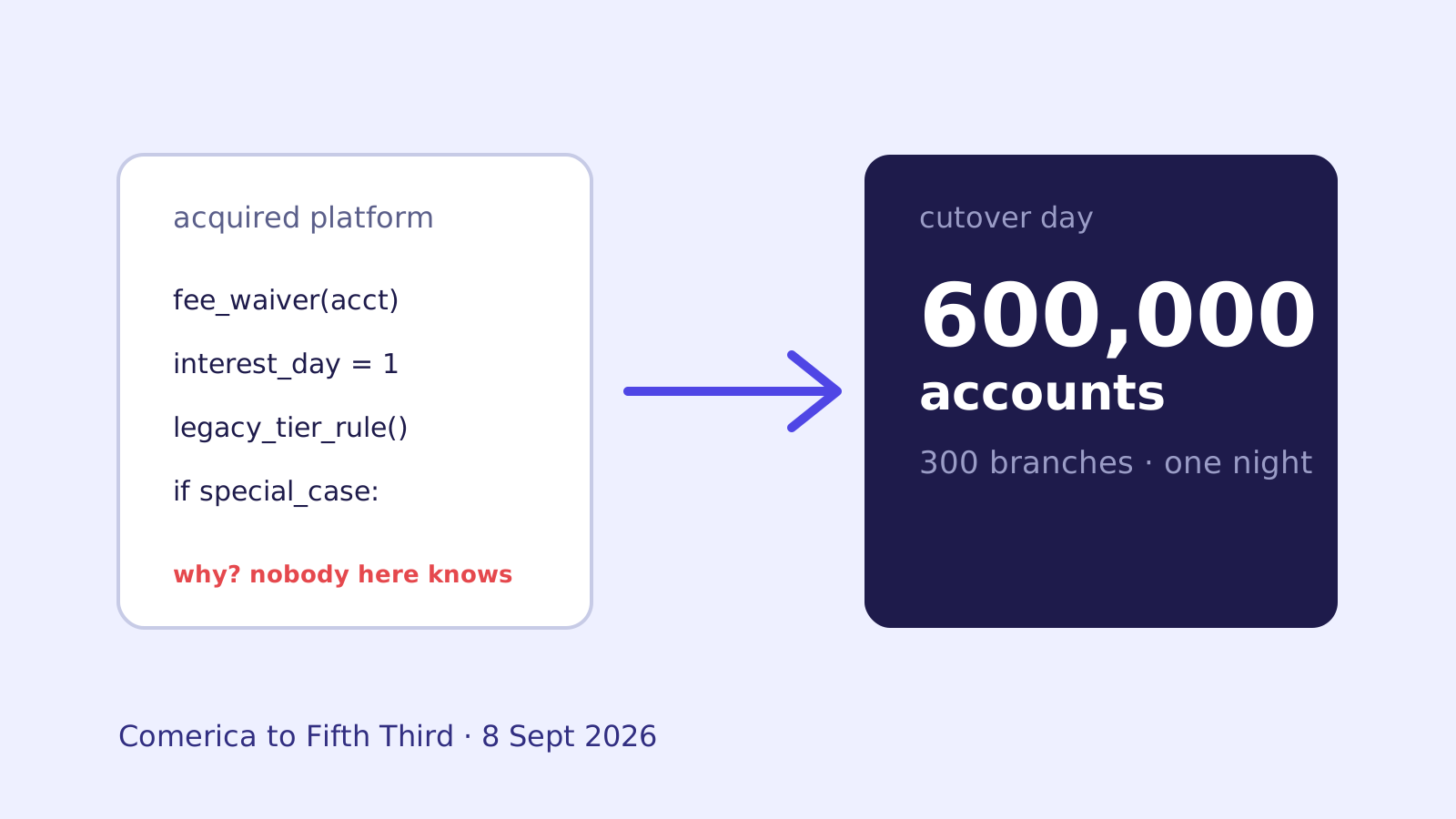
Your acquisition closed. Who can explain the systems you bought?
A 600,000-account bank conversion left customers locked out on day one. What a cutover asks of the people who know how the acquired systems work.
 Engineering
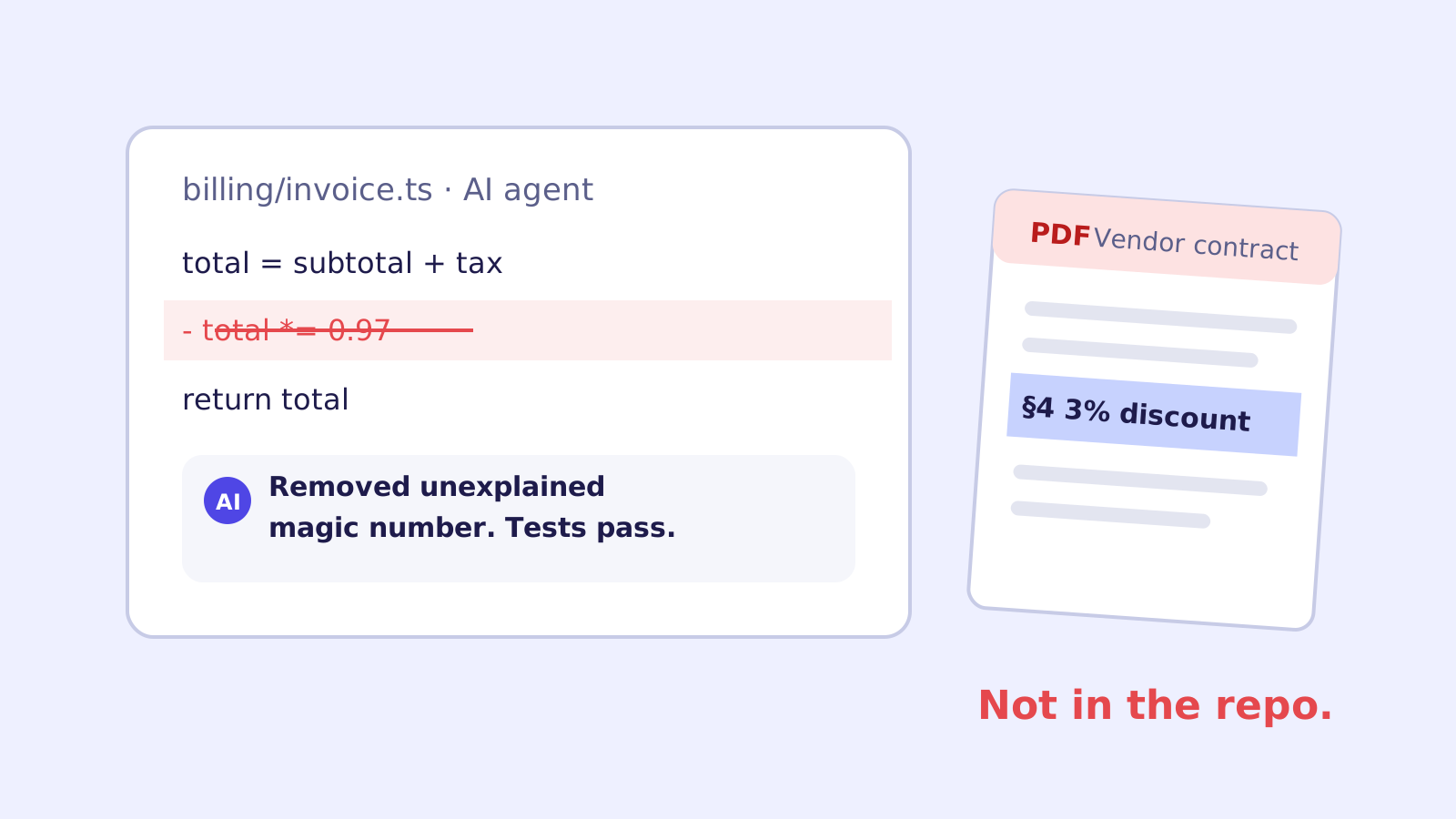
Why AI tools get your business rules wrong
AI tools now delete business rules, explain them, and write new ones. All three go wrong the same way, because the reason behind a rule is rarely anywhere the tool can read.
 Engineering
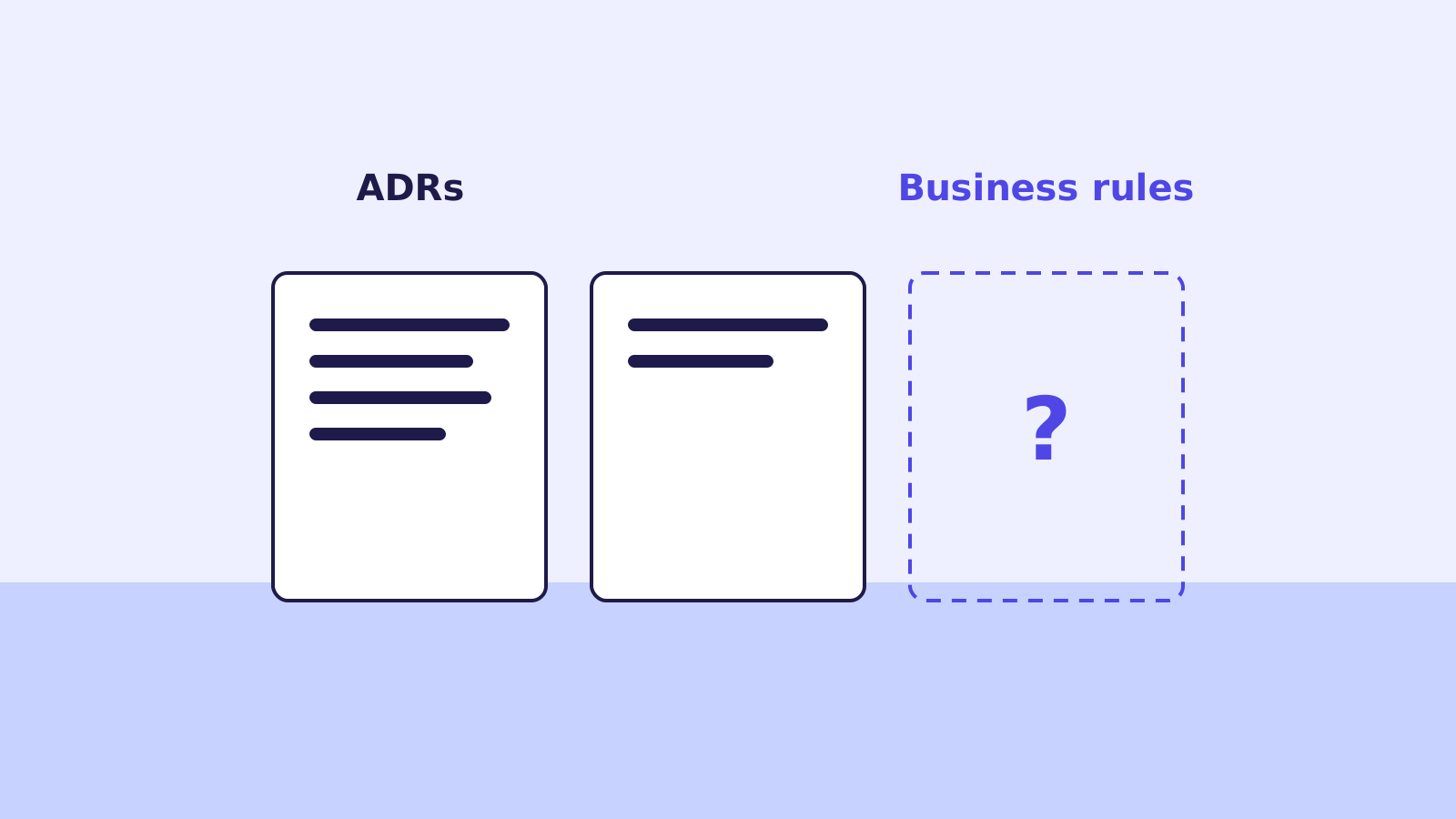
Architecture decision records work. They just don't cover the decisions that break you
ADRs are the standard answer to "why did we build it this way?" They capture technology choices well and miss the business rules that nobody thought of as architecture.
 Engineering
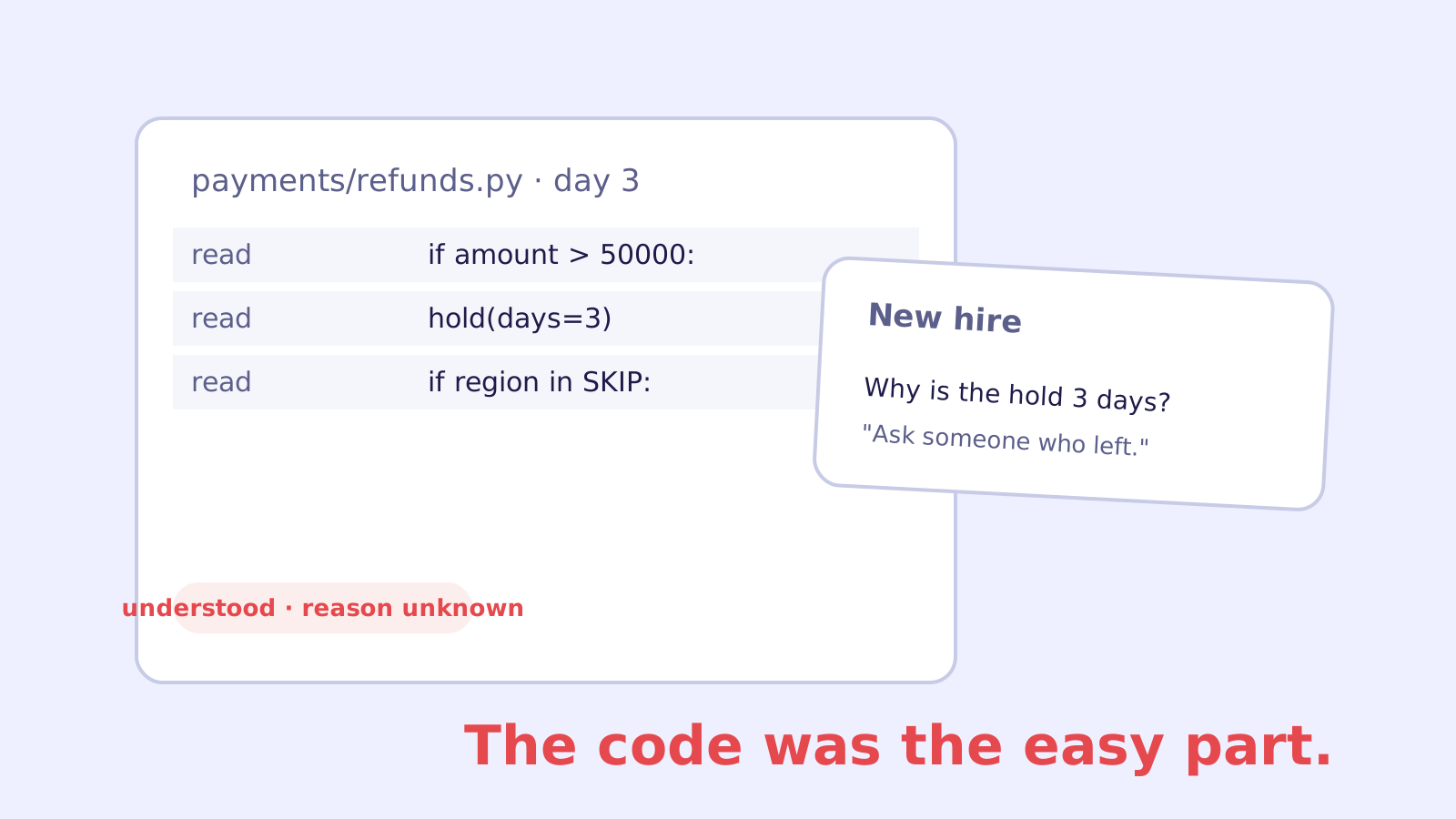
Why new engineers take months to be useful, and what the wiki doesn't tell them
A new hire can read the code on day one. What takes months is learning which odd-looking rules are deliberate, and the people who know are the ones answering the same questions again.
 Leadership
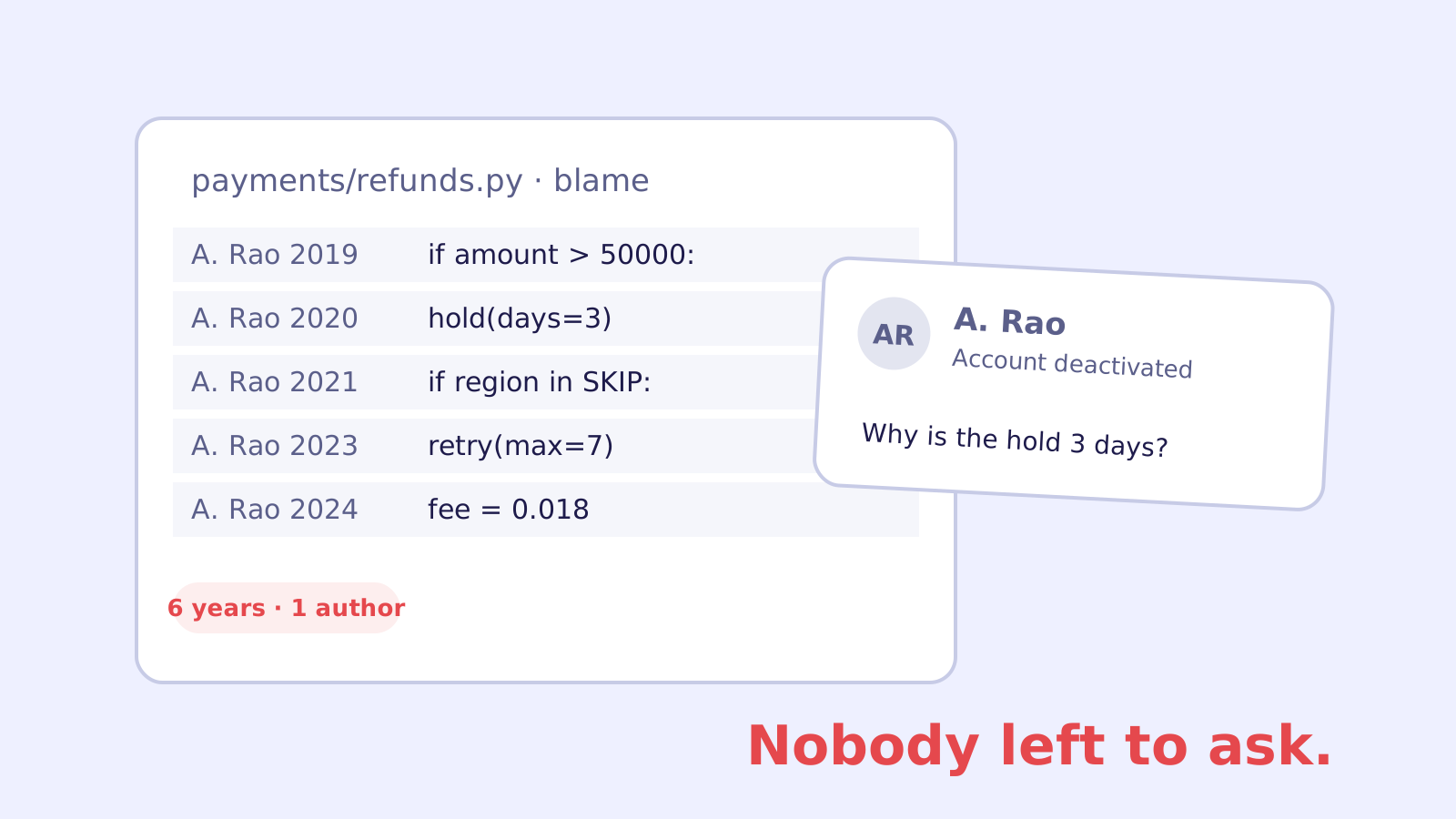
What happens when the only engineer who understands a system leaves
The code stays and the service keeps running. What leaves is the reasoning behind it, and a two-week notice period is the wrong tool for getting it back.
 Leadership
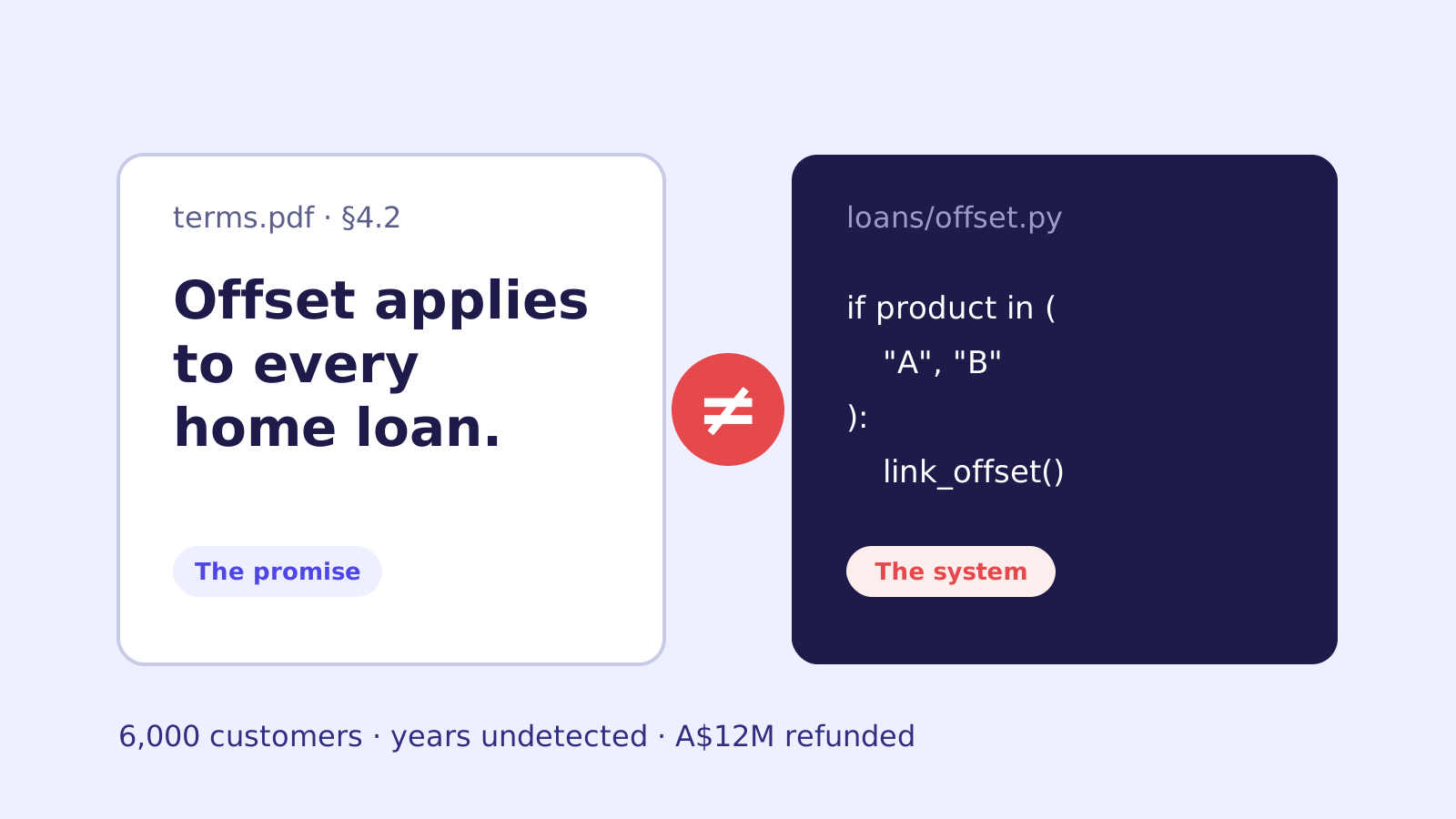
When the system quietly breaks what you promised
Banks have refunded millions for rules that disagreed with their own terms for years. Why compliance testing misses these gaps, and what catches them.
 Research
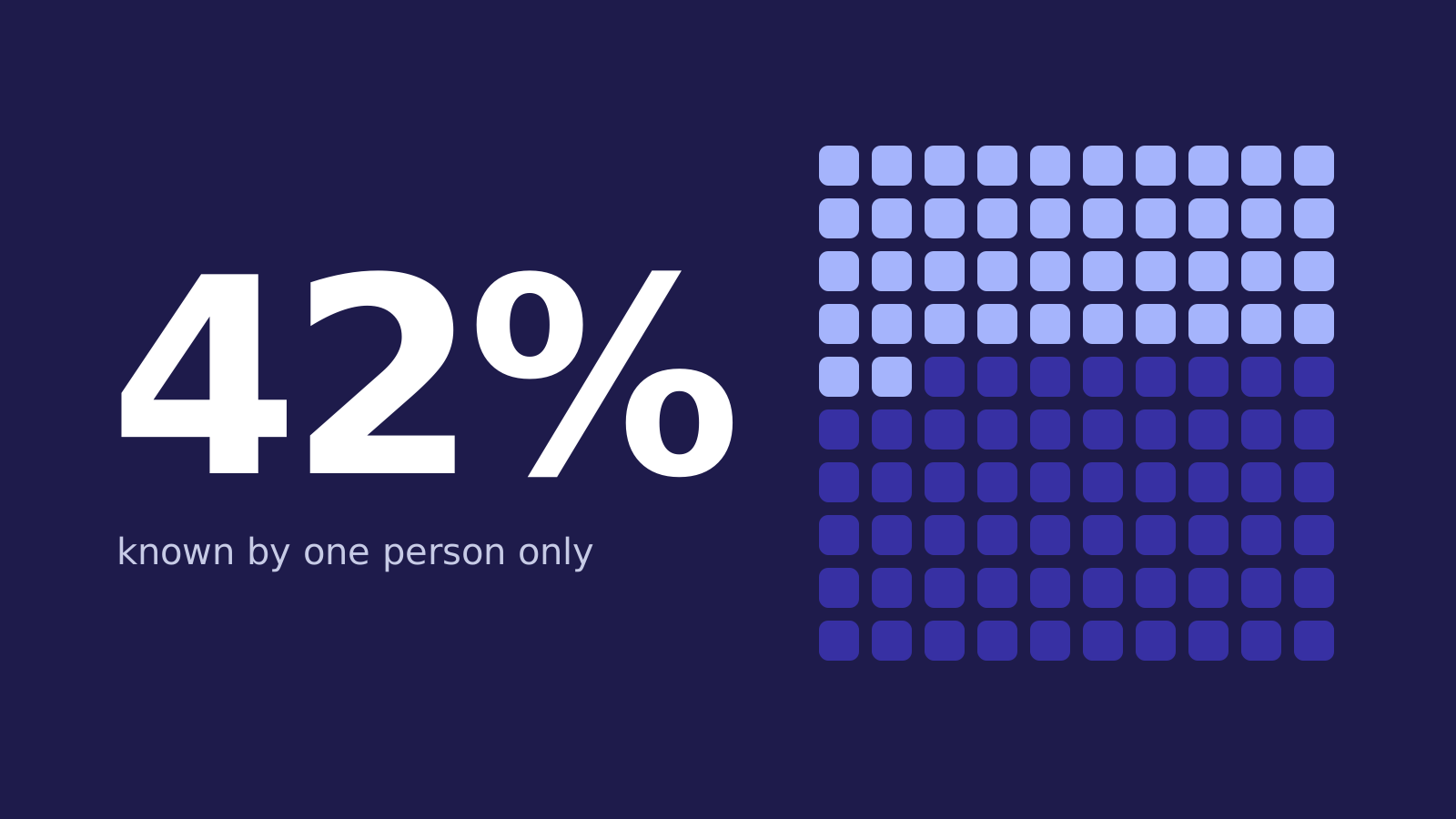
42% of what your company knows lives in one person's head
What the research says about knowledge that never gets written down, and why it hits business rules hardest.
 Engineering
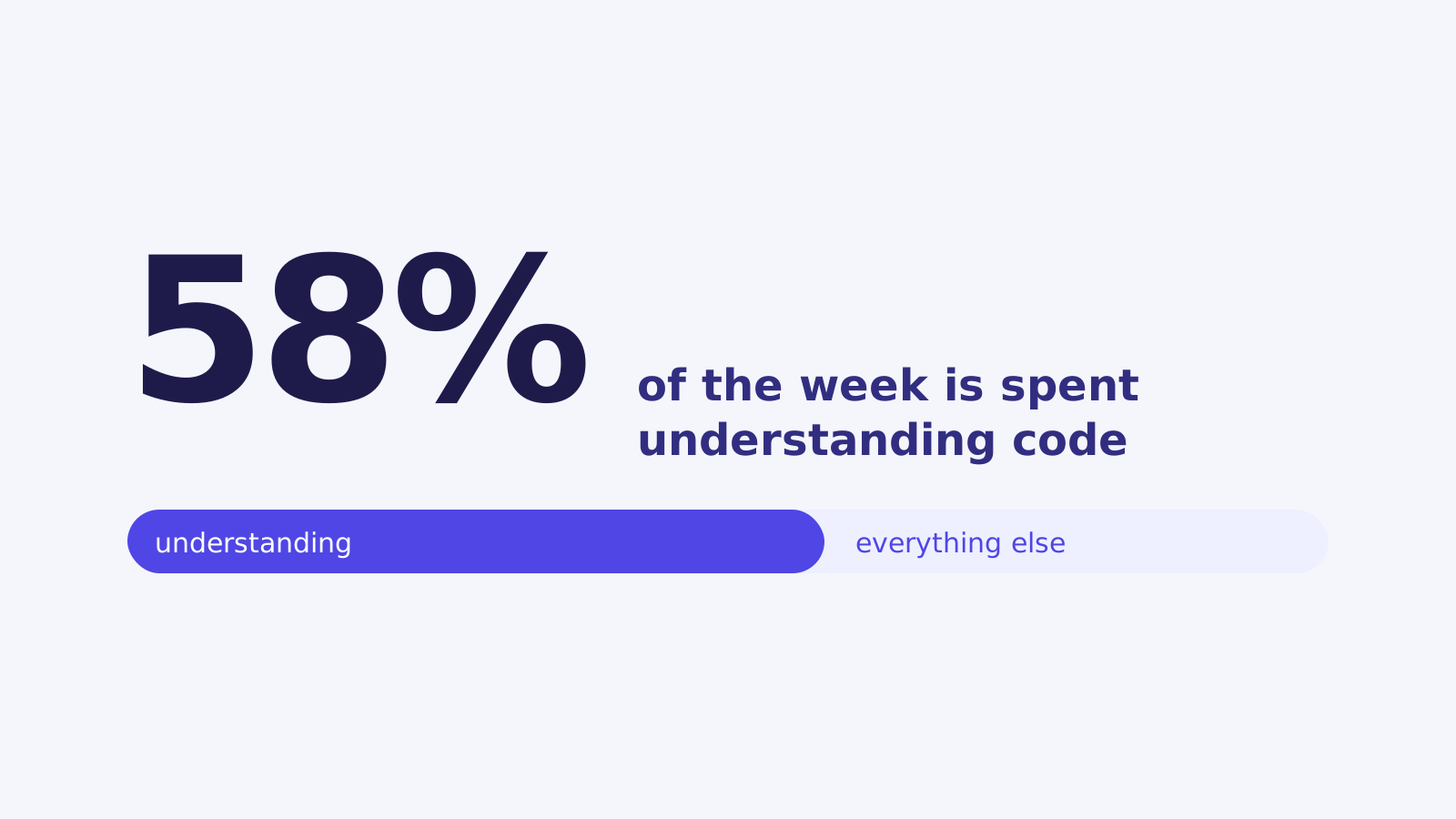
Your engineers spend most of their time understanding, not building
Field studies and developer surveys agree. The bottleneck is not writing code, it is finding out why the code is the way it is.
 Engineering
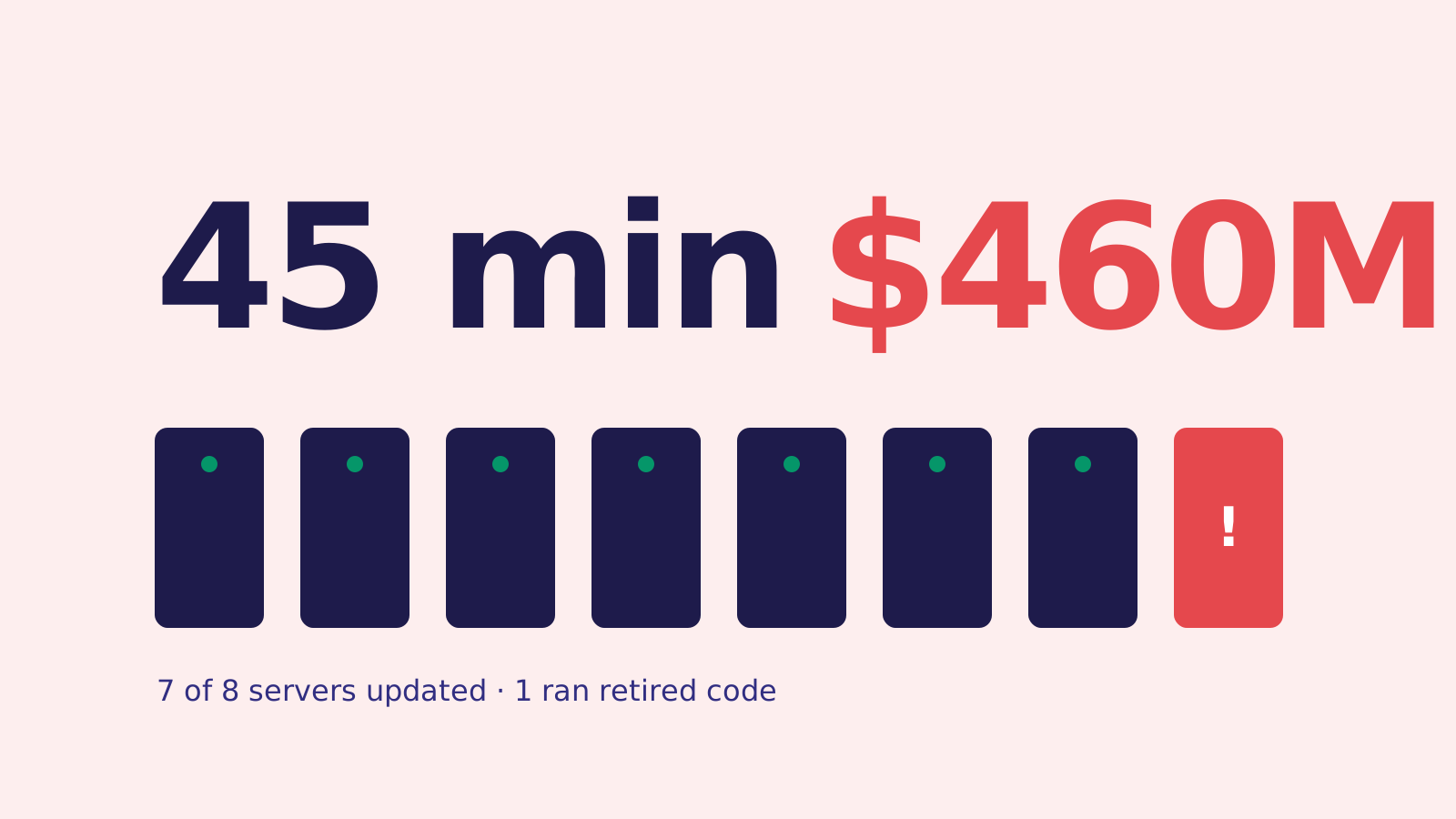
45 minutes, $460 million, and a flag nobody remembered
What the Knight Capital failure teaches about old code, reused switches, and decisions nobody can explain.
 Leadership
Chesterton's fence, for business rules
Don't remove a rule until you know why it was put there. A century-old principle, and why it is so hard to follow in software.
 Research
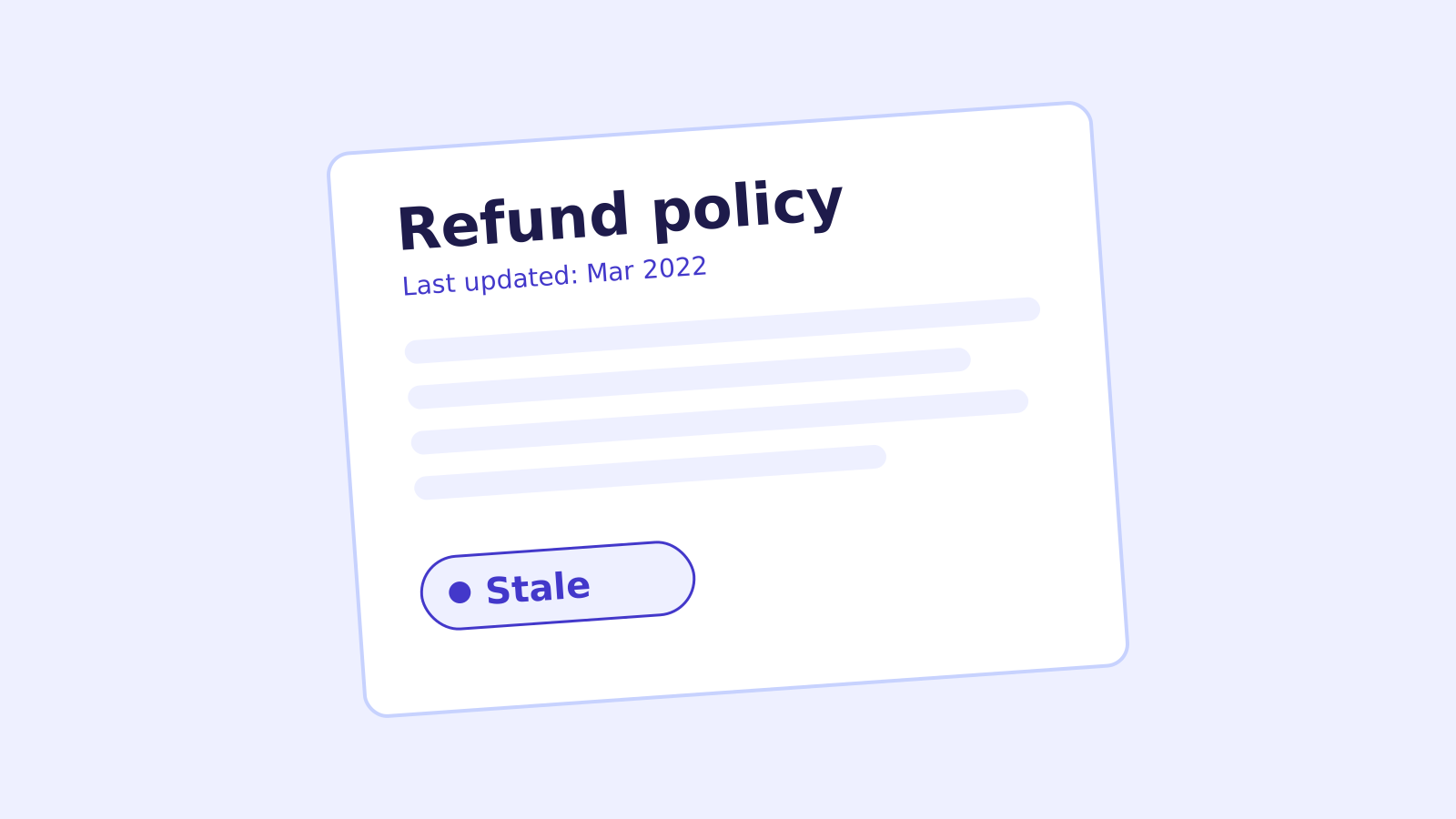
Why documentation goes stale, and what to do instead
Documentation is written once and silently drifts. Records that know when they are out of date work differently.
 om
Why om asks instead of guessing
A model can read what a system does. Only the person who decided knows why, and a confident guess is worse than an honest "unknown".
The path from "can we change this?" to a decision the right people made, with the reason on record.Read the use case
- Start here
45 minutes, $460 million, and a flag nobody remembered
What the Knight Capital failure teaches about old code, reused switches, and decisions nobody can explain.
- Engineering
Why AI tools get your business rules wrong
AI tools now delete business rules, explain them, and write new ones. All three go wrong the same way, because the reason behind a rule is rarely anywhere the tool can read.
- Engineering
Architecture decision records work. They just don't cover the decisions that break you
ADRs are the standard answer to "why did we build it this way?" They capture technology choices well and miss the business rules that nobody thought of as architecture.
Capture what a leaving person knows about the rules they decided, before their last day.Read the use case
- Start here
What happens when the only engineer who understands a system leaves
The code stays and the service keeps running. What leaves is the reasoning behind it, and a two-week notice period is the wrong tool for getting it back.
- Research
42% of what your company knows lives in one person's head
What the research says about knowledge that never gets written down, and why it hits business rules hardest.
Let new engineers and managers learn why the system works the way it does, without waiting on colleagues.Read the use case
- Start here
Why new engineers take months to be useful, and what the wiki doesn't tell them
A new hire can read the code on day one. What takes months is learning which odd-looking rules are deliberate, and the people who know are the ones answering the same questions again.
- Engineering
Your engineers spend most of their time understanding, not building
Field studies and developer surveys agree. The bottleneck is not writing code, it is finding out why the code is the way it is.
- Research
Why documentation goes stale, and what to do instead
Documentation is written once and silently drifts. Records that know when they are out of date work differently.
Find where a rule in your systems does something different from what your terms, rate sheets or regulators say, before a customer or a regulator finds it.Read the use case
- Stories
A billing error ran for decades. How would you find yours?
A Texas city overcharged electricity customers for roughly 30 years because a rule did something different from what its ordinance said. A customer noticed first.
- Leadership
When the system quietly breaks what you promised
Banks have refunded millions for rules that disagreed with their own terms for years. Why compliance testing misses these gaps, and what catches them.
Retire the "temporary" rule that has been costing you for years. om lists every rule past its review date with its owner, and asks them to keep, change or retire it.Read the use case
Capture why the acquired company's systems work the way they do while the people who built them are still there.Read the use case
Show who decided each business rule, why, and when it last changed.Read the use case
- Leadership
Can you show an auditor which contract term a rule enforces?
A UK regulator fined Deloitte £6.05 million for missing the contract terms behind overpayments Go-Ahead's rail subsidiaries booked as profit. The same link, from contract to rule, is the one your own audit will ask for.
- Leadership
The auditor asks who approved this rule. What do you show?
An Abu Dhabi regulator fined an audit firm for thin evidence and no record of who supervised. The same question lands on every company's own controls.
For engineering teams moving a legacy system to a modern platform, and deciding which of its rules come along.Read the use case
- Research
Payroll went live and people are underpaid. Where do you look?
Sydney Water replaced its payroll system in July 2026. By late September three unions were taking industrial action over pay that arrived late, short or not at all. The question every migration team should ask before go-live is which rules the old system was applying.
- Research
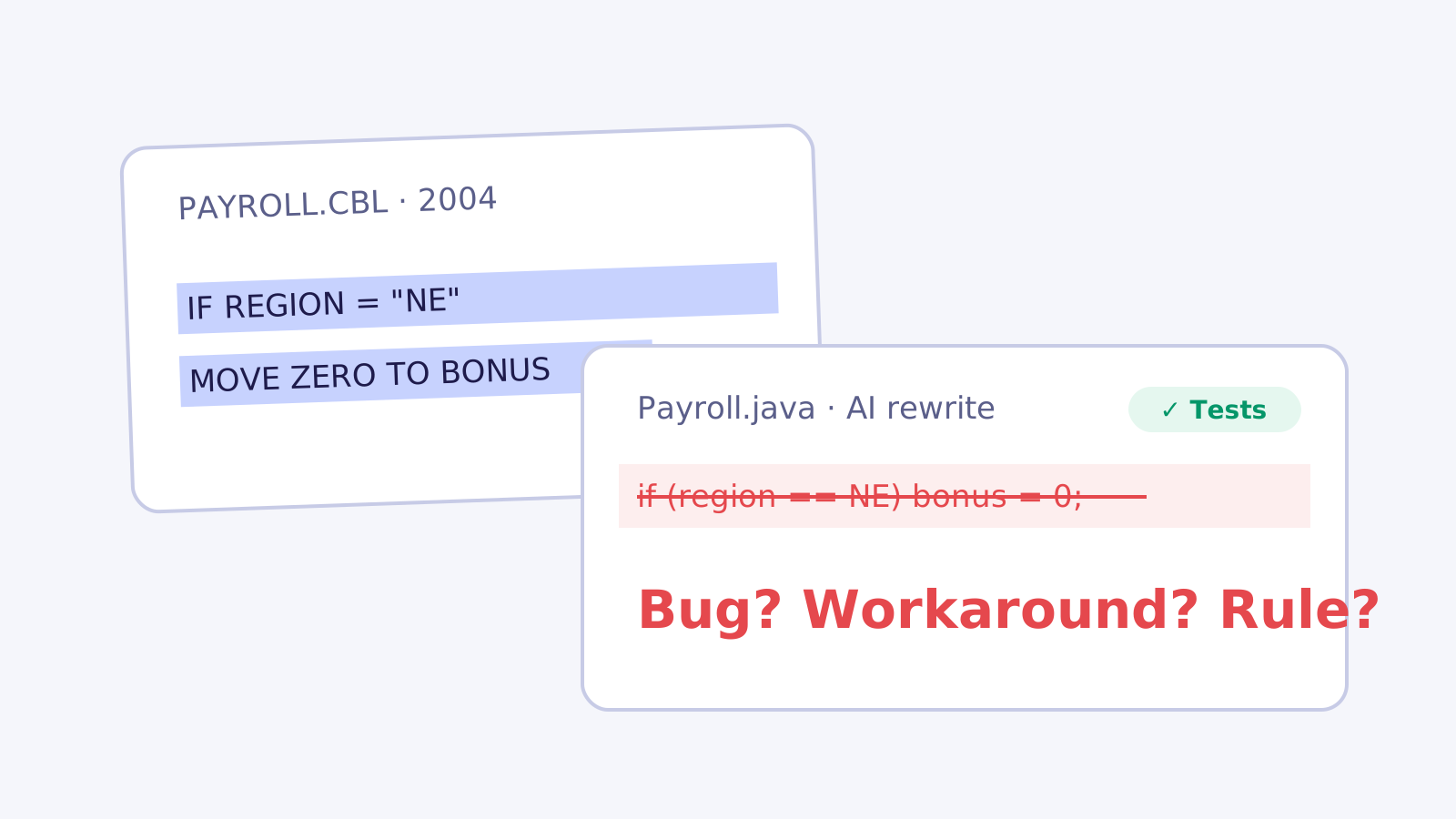
Will AI modernize your legacy system, or just rewrite it?
AI can translate a legacy application into a modern language in days. Whether the new system still does what the business needs depends on reasons that were never written into the code.